Wedding season 2026 is about to peak — and this year, couples are doing things differently.
Etsy’s Spring/Summer 2026 Trend Report names garden romance and outdoor weddings as one of the defining trends of the season. Gen Z and millennial couples are trading ballroom formality for wildflower arrangements, natural settings, and celebrations that feel personal over polished.
But behind every “effortlessly beautiful” outdoor wedding? A spreadsheet. Probably several.
Whether you’re planning a 200-guest formal event or a 30-person garden ceremony, the logistics are the same: budget, vendors, guest list, timeline, seating, and 47 decisions you didn’t know existed. Here’s the complete system to stay organized through all of it.
The Average Wedding Has 100+ Moving Pieces
This isn’t an exaggeration. Between venue booking, catering, photography, flowers, attire, invitations, music, transportation, rehearsal dinner, day-of timeline, and the honeymoon — a wedding is a project management exercise disguised as a celebration.
Most couples start planning 10-14 months out. By month 6, if you don’t have a system, you’re drowning in group texts, scattered notes, and a vague sense that you forgot something important.
Why Printable Planners Beat Wedding Apps
Before we get into the tools, let’s address the question: why not just use The Knot, Zola, or another wedding app?
Wedding apps are great for vendor discovery and RSVP collection. But they come with trade-offs:
- Vendor lock-in: Many apps push their preferred vendors and take commissions
- Feature bloat: You end up managing an app instead of managing your wedding
- Data ownership: Your budget, guest list, and timeline live on someone else’s server
- Couples planning together: Shared spreadsheets and printable binders work on any device with zero logins
A printable wedding planner gives you one document you both control — customizable, offline-friendly, and built around how you plan, not how an app wants you to plan.
6 Planning Tools That Prevent Wedding Chaos
1. A Centralized Wedding Binder
One document. Everything lives here: budget, vendor contacts, guest list, timeline, inspiration, contracts. Not across 4 apps, 3 notebooks, and 12 browser tabs.
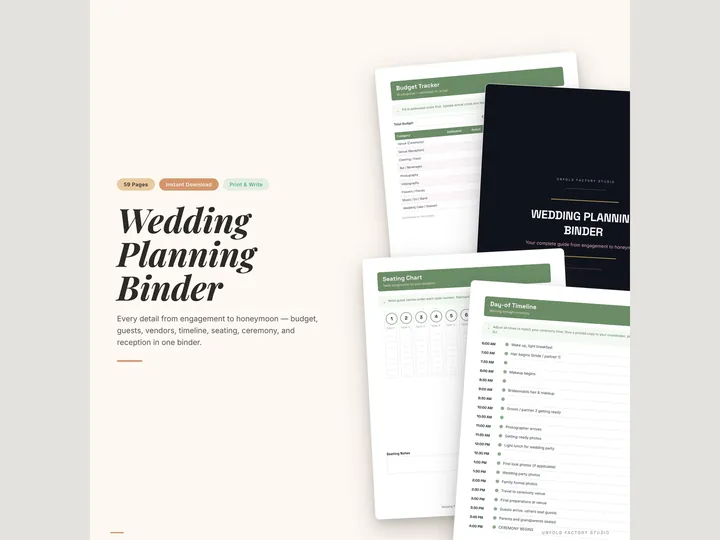
Our Wedding Planning Binder is a 50-page printable system covering every phase — from “just engaged” through the honeymoon. Budget tracker, vendor comparison sheets, guest list manager, seating chart templates, and a 12-month countdown checklist.
2. A Real Budget Tracker (Not a Guess)
The average U.S. wedding costs $35,000-$40,000 (2025 data from The Knot). But most couples don’t track spending until they’re already over budget. The fix: a dedicated budget tracker that itemizes every category with estimated vs. actual costs.
Key budget categories most couples underestimate:
- Tips and gratuities (10-20% of vendor costs — rarely budgeted)
- Alterations ($200-$800 for bridal attire)
- Day-of emergencies (5% contingency fund)
- Postage (invitations + thank-you cards add up fast)
- Overtime fees (DJ, photographer, and venue often charge by the hour after contract time)
A simple rule: take your expected budget, add 15%, and plan to that number. The 15% buffer isn’t pessimism — it’s realism.
3. A Guest List With Built-in RSVP Tracking
Guest management gets complicated fast. Who’s invited to the ceremony only? Who gets a plus-one? Who has dietary restrictions? Who hasn’t RSVP’d with 2 weeks to go?
A structured guest list template with columns for invitation sent, RSVP status, meal choice, table assignment, and gift received eliminates the chaos. One sheet, always current.
4. A Vendor Comparison Worksheet
You’ll get quotes from 3-5 vendors per category. Without a comparison system, you’re relying on memory and vibes. A vendor worksheet tracks:
- Contact info and availability
- Package details and pricing
- Deposit amounts and payment schedules
- Contract status
- Reviews and ratings
5. A Day-of Timeline
The single most important document at your wedding. Minute-by-minute: when the florist arrives, when photos start, when the ceremony begins, when the cake gets cut, when the DJ wraps up.
Your coordinator, photographer, caterer, and DJ all need a copy. Build it once, share it everywhere.
6. A Post-Wedding Tracker
The wedding ends. The work doesn’t. Thank-you cards, vendor reviews, name changes, gift returns, final vendor payments, honeymoon logistics. A post-wedding checklist keeps this from becoming a months-long drag.
The 2026 Wedding Trend That Matters Most for Planning
Etsy’s trend expert Dayna Isom Johnson notes that couples are “rewriting the rules” — choosing garden romance, natural settings, and slower celebrations over traditional formality.
What this means for planning: outdoor weddings introduce weather contingencies, permit requirements, power/lighting logistics, and terrain considerations that indoor venues handle automatically. The planning overhead is actually higher for a “simple” garden wedding than a hotel ballroom.
More reason to have bulletproof systems in place.
12-Month Planning Timeline
Not sure when to do what? Here’s the standard timeline:
- 12-10 months out: Set budget, book venue and photographer, choose wedding party
- 9-8 months out: Book remaining vendors (caterer, florist, DJ, officiant), shop for attire
- 7-6 months out: Send save-the-dates, plan honeymoon, start guest list
- 5-4 months out: Order invitations, finalize menu, book rehearsal dinner venue
- 3-2 months out: Mail invitations, finalize seating, schedule fittings
- 1 month out: Confirm all vendors, create day-of timeline, obtain marriage license
- 1 week out: Final headcount to caterer, rehearsal, delegate day-of tasks
Start Planning Now — Even If Your Wedding Is Fall or Winter
Wedding vendors book 8-12 months out for peak season (June-October). If you’re getting married in fall 2026, your planning window is right now. Key March-April milestones:
- Lock in venue and photographer
- Set final budget and payment schedule
- Send save-the-dates
- Begin guest list (expect 3-4 revisions)
Frequently Asked Questions
How far in advance should I start planning a wedding?
Most wedding planning timelines recommend 10-14 months. This gives you enough time to book popular vendors, shop for attire with time for alterations, and spread out deposits so the financial hit isn’t all at once. Even for smaller, simpler weddings, 6-8 months is the minimum to avoid rush fees and limited availability.
What’s a realistic wedding budget for 2026?
The national average is $35,000-$40,000, but this varies dramatically by region and guest count. A 50-person wedding in a mid-cost city can be done well for $15,000-$20,000. The key is setting your number before you start booking, then tracking every expense against it. Always add a 15% contingency buffer.
Do I need a wedding planner or can I do it myself?
It depends on your wedding size and complexity. For 100+ guest weddings, a day-of coordinator ($1,000-$2,500) is almost always worth it — they handle vendor arrivals, timeline management, and emergencies so you can enjoy the day. For smaller weddings, a detailed printable planning binder and a reliable friend with a timeline can handle the logistics.
What documents should I bring to vendor meetings?
Bring your budget breakdown, a list of questions specific to that vendor category, your event date and timeline, the venue layout (if available), and a vendor comparison worksheet to record quotes and package details. Taking notes on your phone gets messy — a structured worksheet lets you compare vendors side by side later.
What’s the most commonly forgotten wedding expense?
Tips and gratuities. Most couples budget for vendor base costs but forget that tipping is customary for caterers (15-20%), bartenders ($50-$100 each), delivery drivers ($10-$20 each), hair/makeup artists (15-20%), and musicians ($25-$50 per musician). This can add $1,000-$3,000+ to your total.
Your Wedding Deserves Better Than Scattered Notes
You’re about to plan one of the biggest events of your life. Give it the same organizational rigor you’d give a major project — because that’s exactly what it is.
Start organized, stay organized: Check out our Wedding Planning Binder — 50 pages covering budget, vendors, guests, timeline, and every detail in between. Browse our full collection on Etsy.
Written by Unfold Factory Studio — we build premium digital templates for budgeting, health tracking, planning, and personal growth. Every template is designed to work on day one with zero setup.