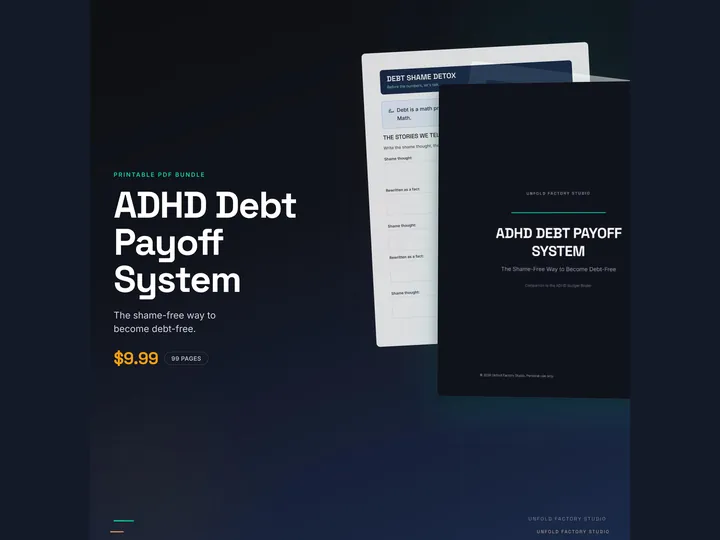
You’ve tried budgeting. Probably more than once.
You downloaded the spreadsheet. You set up the categories. You tracked expenses for four days. Then you forgot on day five, felt guilty on day six, avoided looking at it on day seven, and by day ten the whole system was dead. Not because you don’t care about money — because the system wasn’t built for your brain.
Standard budgets are designed for neurotypical consistency. They assume daily tracking. They assume 15+ spending categories make sense. They assume that a number in a cell is motivating. For ADHD brains, every one of those assumptions is wrong.
A 2024 study in the Journal of Attention Disorders found that adults with ADHD were 3x more likely to report financial management difficulties than neurotypical peers — not due to lower income or intelligence, but due to executive function challenges: working memory, impulse regulation, and task initiation.
The problem isn’t you. The problem is the tool. Here’s how to build a budget that actually works with ADHD — not against it.
Why Traditional Budgets Fail ADHD Brains
Let’s be specific about what goes wrong:
Too many categories. A 20-category budget requires constant decision-making about where each purchase goes. For an ADHD brain already dealing with decision fatigue, this is a system designed to be abandoned. Every ambiguous purchase (“is this restaurant meal ‘dining out’ or ‘entertainment’?”) creates friction that compounds daily.
No visual feedback. A spreadsheet full of numbers provides zero dopamine. Your brain needs to see progress — color changes, progress bars, visual indicators that something is happening. A column of figures in a monochrome grid is invisible to the ADHD attention system.
Guilt-based design. Most budgets highlight overspending in red. They show negative numbers. They’re built around restriction. For ADHD brains that already struggle with rejection sensitivity and shame, a budget that punishes you for every slip becomes emotionally unsafe — and emotionally unsafe tools get avoided.
Out of sight, out of mind. If your budget lives in a spreadsheet you have to remember to open, it doesn’t exist. ADHD brains don’t maintain background awareness of things they can’t see. The tool needs to come to you, not wait for you to remember it.
Dopamine-Focused Budget Design
An ADHD-friendly budget isn’t a dumbed-down budget. It’s a redesigned budget that leverages how your brain actually processes information and motivation.
Simplified categories (5-7 max). Collapse your spending into broad buckets: Bills, Needs, Wants, Savings, Debt. That’s five. Maybe add Subscriptions and Fun Money for seven. Every purchase fits clearly into one bucket with zero ambiguity. Less decision-making means less friction.
Visual progress indicators. Color-coded progress bars that fill as you spend toward your limit in each category. Green when you’re under 50%, yellow at 75%, red at 90%+. Your brain processes this instantly — no math required, no scanning columns of numbers. You glance and you know.
Celebration of wins. Hit your savings goal for the week? The system should acknowledge it. Stayed under budget in a category? That’s visible. ADHD brains are motivated by immediate positive feedback, not by the abstract future reward of “financial security in 30 years.” Build the dopamine hits into the tracking itself.
Color coding everything. Each category gets a consistent color across every page and view. Bills are always blue. Wants are always orange. Your brain builds visual associations faster than it processes labels — use that.
Our ADHD Budget Binder is built on these exact principles — simplified categories, visual progress tracking, celebration markers, and color-coded layouts designed for neurodivergent brains.
The 3 Biggest ADHD Money Challenges (and Systems That Help)
1. Impulse Spending
This is the big one. Impulse purchases aren’t about willpower — they’re about dopamine. Your brain craves novelty and immediate reward, and online shopping delivers both in seconds.
The system: Create a 24-hour list. When you want to buy something unplanned, add it to the list with the date. If you still want it 24 hours later, it’s approved from your “Wants” budget. Research from Behavioral Economics journals suggests this simple delay reduces impulse purchases by 40-60% because the dopamine spike fades and rational evaluation takes over.
Track your impulse list in your budget binder. Over time, you’ll see how many items you didn’t buy — and that becomes its own motivating data point.
2. Forgotten Bills
Missed payments aren’t carelessness — they’re working memory failures. You know the bill exists. You intend to pay it. It simply falls out of active memory because something else demanded your attention.
The system: Automate every possible bill. For the ones that can’t be automated, create a visual bill calendar — a single page showing every bill’s due date for the month, with checkboxes. Pin it where you’ll see it daily. Pair each bill due date with a phone alarm labeled with the specific bill name and amount.
The goal is removing the bill from your working memory entirely and putting it into an external system that doesn’t forget.
3. Inconsistent Income Tracking
If your income varies — freelance, gig work, commissions, irregular hours — ADHD makes the variability even harder to manage. You can’t budget consistently when you don’t know what’s coming in.
The system: Use a rolling average instead of exact monthly income. Track the last 3 months of income, calculate the average, and budget based on 80% of that number. The 20% buffer absorbs fluctuation without requiring you to rebuild your budget every month. Any surplus goes directly to savings or debt — automatically, not by decision.
Weekly Check-ins Beat Daily Tracking (Every Time)
Here’s the most important structural change for ADHD budgeting: stop trying to track daily.
Daily expense logging is a habit that requires daily initiation — and daily initiation is exactly what ADHD makes hardest. Miss one day and the guilt starts. Miss three and the system feels broken.
Instead, do a weekly money check-in. Every Sunday (or whatever day works), spend 15-20 minutes:
- Review bank and credit card transactions for the week
- Categorize spending into your 5-7 buckets
- Update your visual progress bars
- Check upcoming bills for the next 7 days
- Celebrate one win from the week (stayed under budget somewhere? Resisted an impulse buy? Paid a bill early?)
Weekly tracking is forgiving by design. If you miss a week, you do two weeks next Sunday. No spiral. No guilt. The system absorbs inconsistency because it was built to expect it.
Sleep and Financial Decisions: The Connection Nobody Talks About
This might seem like an unexpected detour, but stay with us — it matters.
A 2023 study in Sleep journal found that sleep-deprived adults showed significantly increased impulsive financial behavior, including larger purchases, less price comparison, and reduced ability to delay gratification. For ADHD brains that already struggle with impulse control, poor sleep is like removing the last guardrail.
Sleep quality directly impacts your financial decisions. When you’re running on 5 hours, your prefrontal cortex — the part of your brain responsible for planning, impulse control, and long-term thinking — operates at reduced capacity. Every financial decision you make that day is compromised.
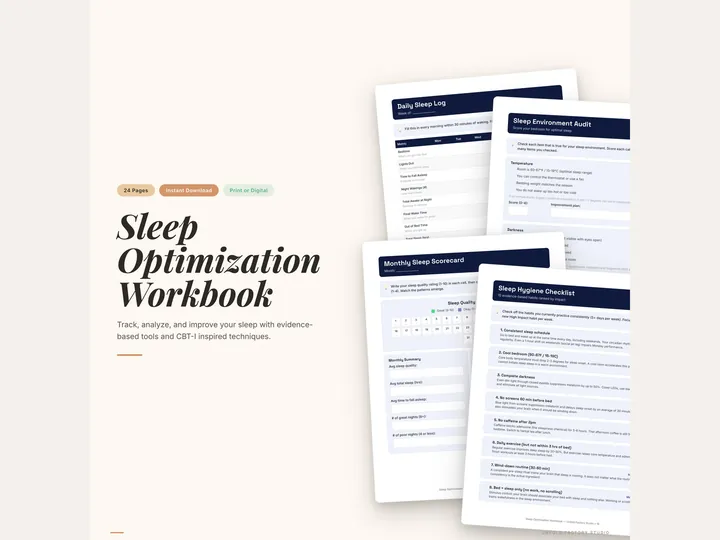
This is why we recommend pairing your budget system with a sleep tracking habit. Our Sleep Optimization Workbook includes sleep quality tracking, bedtime routine builders, and environment assessments — all designed to improve the one thing that makes every other system work better.
Better sleep won’t fix your budget. But it will make you significantly better at sticking to it.
Frequently Asked Questions
How is an ADHD budget different from a regular budget?
An ADHD-friendly budget reduces executive function demands at every step. That means fewer categories (5-7 instead of 15-20), visual progress indicators instead of raw numbers, weekly tracking instead of daily, and built-in flexibility that doesn’t punish missed days. The core math is the same — income minus expenses — but the interface is redesigned for how ADHD brains actually process information and maintain habits.
What’s the best budgeting method for ADHD?
The envelope method (physical or digital) works well because it’s visual and concrete. You allocate money into category “envelopes” at the start of the month, and when an envelope is empty, spending in that category stops. The visual element — watching the envelope shrink — provides real-time feedback that spreadsheet numbers can’t. Pair it with a weekly check-in instead of daily tracking for the best ADHD fit.
How do I stop impulse spending with ADHD?
Start with a 24-hour rule: log the item and wait one full day before purchasing. This breaks the dopamine-impulse-purchase cycle by introducing a delay. Track these delayed purchases in a list — you’ll find that 50%+ of items lose their appeal overnight. For online shopping specifically, remove saved credit cards from browsers, add friction to the purchase process, and unsubscribe from marketing emails that trigger browsing sessions.
Should I use a budgeting app or a printable template?
For ADHD, physical or printable templates often work better than apps. Apps rely on you remembering to open them — and out of sight is out of mind for ADHD brains. A printed budget pinned to your wall or refrigerator is always visible. That said, the best tool is the one you’ll use. If you respond well to phone notifications and digital interfaces, an app can work — just pair it with a visual tracker you can see without unlocking your phone.
Ready to build a budget that works with your brain? Browse our full collection of ADHD-friendly financial templates — designed for neurodivergent brains, not against them.
Written by Unfold Factory Studio — we build premium digital templates for budgeting, health tracking, planning, and personal growth. Every template is designed to work on day one with zero setup.