New Year’s resolutions have an 88% failure rate. That stat comes from research published in the Journal of Clinical Psychology — and if you’ve ever abandoned a January goal by Valentine’s Day, you already knew it without the data.
The problem isn’t willpower. It’s the timeline. Twelve months is too long. The finish line is invisible, there’s no urgency, and by February you’ve already rationalized that you’ll “start fresh next month.” Then next month becomes next quarter. Then it’s December again.
Ninety days changes everything. A 90-day sprint — June 1 through Labor Day — is short enough to maintain urgency, long enough to produce real results, and aligned with a season where energy, daylight, and motivation are naturally higher.
Here’s the framework.
Why Q3 Goals Beat New Year’s Resolutions
Three structural advantages summer goals have over January goals:
Shorter timeline creates urgency. Ninety days means every week counts. You can’t “start next month” when there are only three months total. The compressed timeframe forces specificity — “get in shape” becomes “walk 30 minutes five times per week for 13 weeks” because you have to define what’s actually achievable in the window.
Warmer weather increases capacity. Longer days, better weather, and seasonal energy shifts make summer the easiest time to build physical habits, tackle outdoor projects, and maintain social commitments. January asks you to build new habits during the lowest-energy season of the year. Summer works with your biology instead of against it.
The midsummer check-in prevents drift. At 45 days (mid-July), you’re at the halfway point with a natural moment to evaluate. Are you on track? Falling behind? Need to adjust? This built-in checkpoint doesn’t exist with annual goals, where people coast for months without honest assessment.
The 90-Day Sprint Framework
The framework is simple. One goal per life area, specific enough to measure, with weekly tracking and a midpoint review.
Step 1: Choose one goal per category. Not three. Not five. One.
- Health: one physical habit or health target
- Financial: one money goal with a specific number
- Personal: one growth, learning, or relationship goal
- Home: one project or improvement with a clear end state
Four goals total. That’s your summer sprint. More than four dilutes focus, and diluted focus is how goals die.
Step 2: Make each goal specific and measurable. “Get healthier” is a wish. “Walk 30 minutes five times per week” is a goal. Every goal needs a number, a frequency, and a deadline. If you can’t measure it at the end of 90 days, rewrite it until you can.
Step 3: Set weekly milestones. Break the 90-day goal into 13 weekly checkpoints. If your financial goal is saving $1,500 by September 1, that’s $115/week. Now you know exactly whether you’re on pace every single Friday.
Step 4: Schedule a 10-minute Sunday review. Every week, same day, same time. Review the past week against your milestones, adjust the coming week’s plan, and note what helped or hindered progress. Ten minutes. That’s the entire system.
Concrete Summer Goal Examples
Abstract goals fail. Concrete goals succeed. Here’s what good 90-day summer goals look like:
Health: “Walk 30 minutes, 5 days per week, June through August.” That’s 65 walks over the summer. Track each one. By Labor Day you’ll have logged over 32 hours of walking — enough to measurably impact cardiovascular health, sleep quality, and stress levels. Research from the American Heart Association shows that 150 minutes of moderate walking per week reduces heart disease risk by 30-40%.
Financial: “Save $1,500 for fall travel by September 1.” That’s $500/month or $115/week. Set up an automatic transfer every Friday. Track the balance weekly. Pair this with one spending reduction — cancel an unused subscription, pack lunch twice a week, skip one dining-out night — and the math works without dramatic lifestyle changes.
Personal: “Read 6 books by Labor Day.” Two books per month. Twenty pages per day gets you through most books in 12-15 days. Track progress weekly — are you on pace for two this month? This goal works because it’s specific (6 books), time-bound (by Labor Day), and measurable (you either read them or you didn’t).
Home: “Complete 3 outdoor projects from the maintenance list by August 31.” Pick three, schedule them across the summer (one per month), and budget materials in advance. Power wash the deck in June. Repair the fence in July. Paint the front door in August. Three visible improvements instead of a 20-item list that paralyzes you into doing nothing.
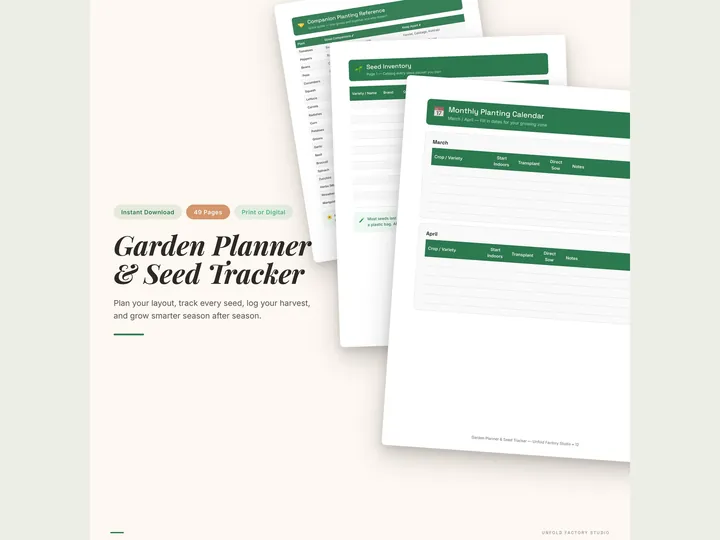
Garden: “Harvest first vegetables by July 15.” If you’re starting a garden this summer, track planting dates, watering schedules, and growth milestones. Our Garden Planner & Seed Tracker maps out your entire growing season with zone-specific planting calendars and harvest tracking.
Weekly Tracking vs. Daily Tracking
This is where most goal-setting systems go wrong. Daily tracking creates guilt spirals. Weekly tracking creates momentum.
When you track daily, one missed day feels like failure. Miss Tuesday’s walk and suddenly the whole week feels ruined. You skip Wednesday too because “I already missed a day.” By Thursday you’ve mentally given up on the week.
Weekly tracking absorbs bad days. You planned 5 walks this week — you did 3. That’s a data point, not a moral failure. Next week, aim for 4 or 5 again. The weekly view shows trends and progress rather than individual stumbles.
The 10-minute Sunday review is the engine of the entire system. Every Sunday:
- Score each goal: on track, behind, or ahead
- Note what worked and what got in the way
- Set specific intentions for the coming week
- Celebrate any milestone you hit — even small ones
That’s it. Ten minutes. This single habit is more valuable than any planner, app, or accountability partner because it forces honest reflection at a consistent interval.
The 45-Day Midpoint Review
Mid-July is your halftime. Block 30 minutes for an honest assessment of each goal:
- On track? Keep going. Don’t change what’s working.
- Slightly behind? Identify the specific bottleneck. Is it time, motivation, or logistics? Adjust the weekly target, not the overall goal.
- Way behind? Pivot. Reduce the goal to something achievable in the remaining 45 days. Saving $1,500 turned into saving $800? That’s still $800 you wouldn’t have saved without the system. Adjust and keep moving.
- Already hit it? Raise the target or add depth. Finished your 6 books by mid-July? Go for 10. Saved $1,500 already? Push to $2,000.
The midpoint review is the mechanism that separates 90-day sprints from abandoned resolutions. It creates a structured moment to be honest with yourself and adjust instead of quietly giving up.
Why Most Goals Fail by Week 4 — and How to Prevent It
Research on habit formation shows that weeks 3-4 are the danger zone. The initial excitement fades, the novelty wears off, and the goal starts competing with daily life for your attention and energy.
Three systems prevent the week-4 collapse:
Accountability that doesn’t depend on motivation. Tell one person your goals and schedule a brief check-in with them at weeks 2, 6, and 12. Not daily texts — just three checkpoints. External accountability survives the motivation dip that internal willpower doesn’t.
Visual progress tracking. A physical tracker you can see — on your wall, your fridge, your desk — creates a visual streak you don’t want to break. Crossing off each week builds psychological momentum. Digital trackers disappear into your phone. Paper trackers stay visible.
Reduce the goal to the smallest possible action. On days when motivation is zero, the only question is: “What’s the smallest version of this I can do?” Don’t feel like a 30-minute walk? Walk for 10. Don’t feel like saving $115? Transfer $20. The streak survives, and tomorrow’s motivation is usually better.
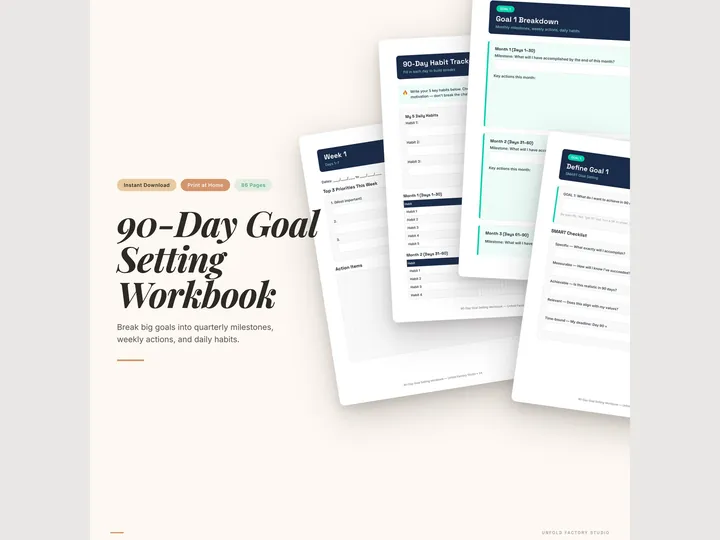
Our Goal Setting Workbook builds all three systems into a 90-day framework — sprint planning, weekly reviews, midpoint assessment, and visual progress tracking in one printable workbook.
The Bottom Line
Ninety days is the perfect goal-setting window. Long enough for meaningful results, short enough to maintain focus, and aligned with a season that works in your favor. Four goals, weekly tracking, one midpoint review. That’s the system.
Start June 1. Review July 15. Finish by Labor Day. See what 13 weeks of focused effort actually produces — you’ll be surprised how much ground you cover when the timeline is tight and the goals are clear.
Frequently Asked Questions
How many goals should I set for a 90-day sprint?
Four maximum — one per life area (health, financial, personal, home). Research on goal pursuit shows that focus drives completion. People who set 1-3 goals accomplish significantly more than people who set 7-10. If four feels like too many, start with two. You can always add goals in your next 90-day cycle.
What if I fall behind on a goal mid-summer?
Use the 45-day midpoint review to honestly assess where you stand. If you’re behind, adjust the target rather than abandoning it. A reduced goal you actually hit builds more confidence and momentum than an ambitious goal you quit. Saving $800 instead of $1,500 is still $800 more than you’d have saved with no system at all.
Should I track goals daily or weekly?
Weekly. Daily tracking sounds disciplined, but it creates guilt spirals — one missed day makes the whole week feel like a failure. Weekly tracking absorbs bad days and shows you the trend instead of individual stumbles. A 10-minute Sunday review is the only tracking habit you need.
How is this different from regular quarterly planning?
The 90-day summer sprint leverages seasonal energy. Longer daylight, warmer weather, and mid-year motivation make June-August the highest-capacity quarter for most people. Standard quarterly planning treats all quarters equally. This framework uses the natural advantages of summer — more outdoor time, higher energy, flexible schedules — to stack the odds in your favor.
Ready to sprint this summer? Browse our full collection of goal-setting and personal growth templates — designed for people who want systems, not fluff.
Written by Unfold Factory Studio — we build premium digital templates for budgeting, health tracking, planning, and personal growth. Every template is designed to work on day one with zero setup.